

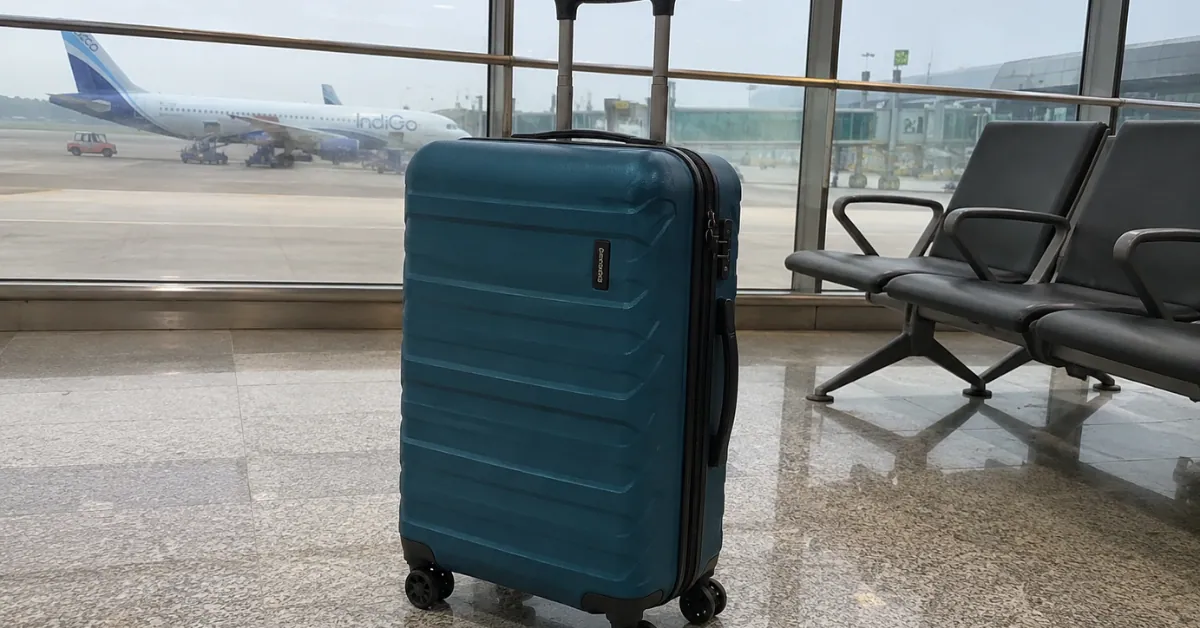
Buying a trolley bag sounds simple. Pick a size, pick a colour, pick a brand. Done.
But if you have ever bought one that looked great in the shop and then gave you trouble three months later — a wobbly wheel, a handle that won’t lock, a zip that gets stuck — you already know it’s not that simple.
Two suitcases can look almost the same and still perform very differently. And a higher price does not always mean a better bag. A ₹2,000 suitcase can sometimes be a better buy than a ₹4,000 one if it has better wheels, a stronger handle, and more practical construction.
The right trolley bag for you depends on where you travel, how often, how much you pack, and your budget. This guide walks through everything worth checking before you buy — size, weight, material, wheels, handle, zips, lock, interior, and warranty — in plain language, without the technical jargon most sites throw at you.
If You Just Want One Answer
For most Indian travellers, start with a lightweight 55 cm cabin trolley if your trips are usually short and you fly regularly. If you mostly travel by train, travel with family, or take longer trips, a medium or large check-in trolley may make more sense — see the size and travel-style sections below for exactly how to decide.
If you want specific product recommendations rather than buying criteria, see our Best Trolley Bags Under ₹5,000 in India, where we compare individual models on size, weight, material, wheels, warranty, and value.
If any of the following apply to you, pay extra attention as you read: you fly very frequently, you travel mostly by train through crowded stations, you’re buying for a family or a long trip, you travel during monsoon season, or your trips regularly involve hill stations — each of these shifts what “right” looks like for you.
Quick Answer: How Do I Pick a Good Trolley Bag?
If you’re short on time, here is the short version. Check these, in this order:
- Pick the right size for your trip
- Check the actual outer dimensions, not just “55cm”
- Check how much the empty bag weighs
- Understand what the shell is made of
- Check the wheels properly — roll it around
- Pull the handle out and push it in a few times
- Open and close the main zip
- Look inside — is the layout actually useful?
- Check that the lock works smoothly
- Decide hard-shell or soft-sided based on how you travel
- Match the bag to your travel style, not the other way round
- Read the warranty terms, not just the number of years
- Check if after-sales service exists near you
- Read recent reviews, not just the star rating
- Compare value, not just price
There is no single “best” trolley bag for everyone. A frequent flyer needs something completely different from a family going on a two-week holiday.
Genuinely in a hurry? Jump straight to Ready to Buy? Here’s Where to Start near the end of this guide — it routes you to our specific picks by budget and travel type. Otherwise, keep reading below for the full explanation of each point.
Related Trolley Bag Guides
- ABS vs Polycarbonate vs Polypropylene Suitcase: Which Material Is Best?
- Trolley Bag Size Guide: 55cm vs 65cm vs 75cm
- 4 Wheels vs 8 Wheels Trolley Bag: Which Is Better?
- Hard-Shell vs Soft-Sided Suitcase: Which Is Better?
- Best Trolley Bags Under ₹5,000 in India
- Best Trolley Bags for Train Travel in India
- Uppercase vs American Tourister: Which Trolley Bag Brand Is Better?
How to Choose the Right Trolley Bag in India
1. Choose the Right Size First
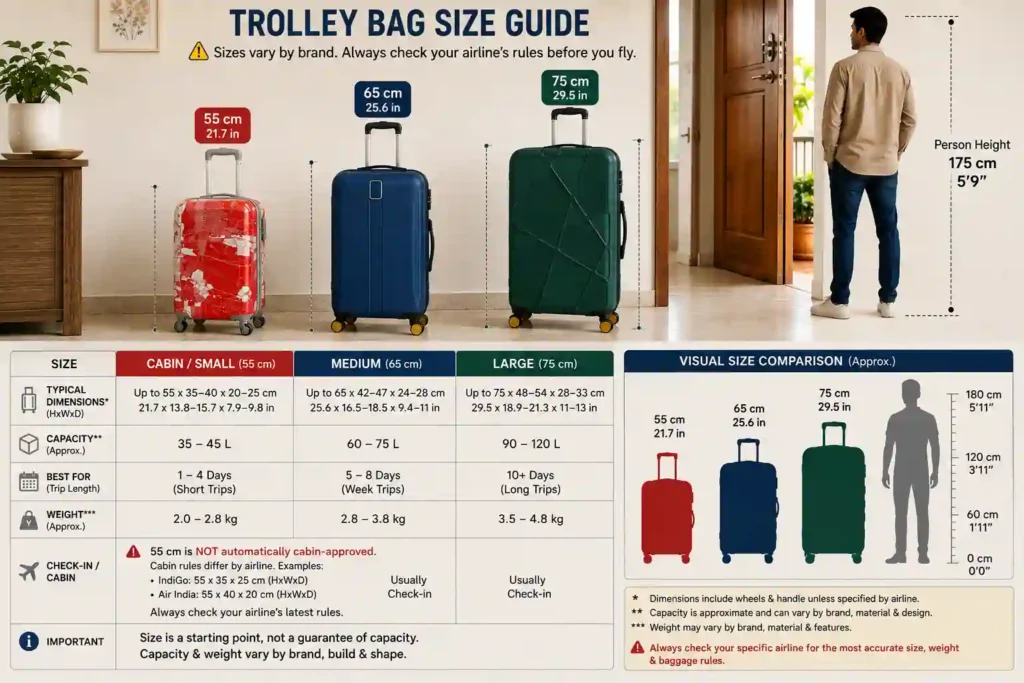
This is where most people start, and it’s a good place to start. Trolley bags in India are usually sold as cabin, medium, and large — but here’s the catch: there’s no fixed rule across brands for what these sizes actually mean.
A 55 cm bag from one brand can be wider, deeper, or heavier than a 55 cm bag from another brand, so treat these as general categories, not industry standards, and always check the manufacturer’s actual dimensions before you buy.
If you fly often, this matters even more. Don’t just trust the words “cabin size” on the box — check the full outer dimensions, including wheels and handle, against your airline’s current cabin baggage rules.
For example, IndiGo currently permits one cabin bag up to 55 × 35 × 25 cm and 7 kg, while Air India’s current standard Economy/Premium Economy allowance is 55 × 40 × 20 cm and 7 kg.
Both airlines’ published dimensions include the bag’s external components, so don’t assume every “55 cm cabin trolley” fits every airline. Rules also change from time to time, so always verify the allowance for your specific booking before travelling.
If you mostly travel by train, you have more room to relax on size, though a very large suitcase is still a pain to lift onto an upper berth or carry through a crowded platform.
For the full size breakdown with all three categories compared in detail, read our Trolley Bag Size Guide: 55cm vs 65cm vs 75cm.
2. Check the Real Dimensions, Not Just the Label
The number printed on the listing (“55cm cabin bag”) is only half the story. What matters more is the actual Height × Width × Depth.
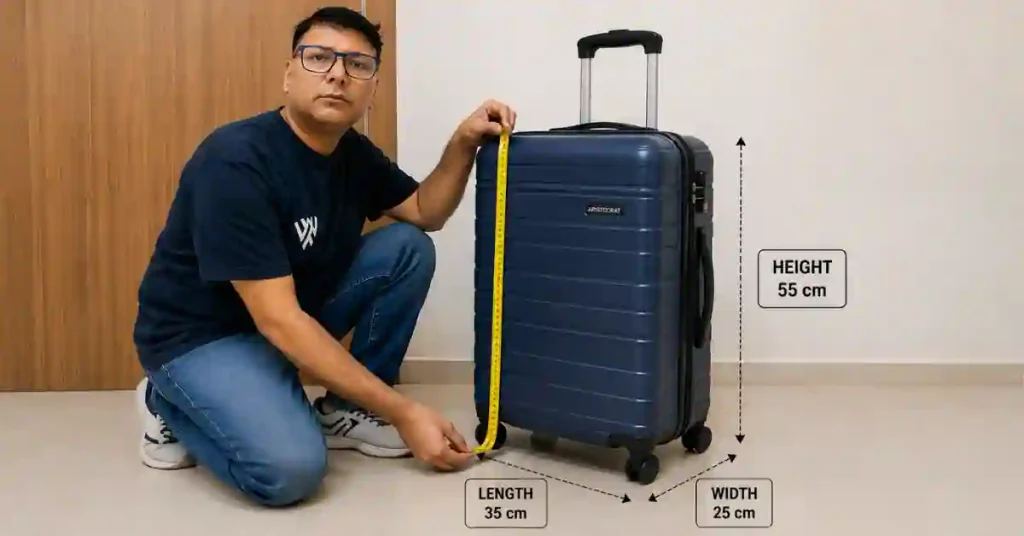
Also check whether these measurements include:
- Wheels
- Handles
- Side grab handles
- Outer pockets
- Expansion zip
This matters a lot for cabin luggage. A bag labelled “55 cm cabin” is not automatically guaranteed to fit your airline’s sizer — some airlines are stricter than others.
Simple tip: Before you fly, always double-check your airline’s current cabin bag rules. Don’t assume last year’s rule still applies.
3. Check the Empty Weight
Every trolley bag weighs something even before you pack it, and this matters more than people realise, especially for flights.
Say your cabin baggage allowance is 7 kg:
- A 2.2 kg bag leaves you around 4.8 kg for your things.
- A 3.2 kg bag leaves you only about 3.8 kg.
That’s a full kilogram of difference — enough for an extra pair of shoes or a jacket.
Rough guide for cabin bags:
- Around 2–2.5 kg — very good for a budget cabin trolley
- 2.5–3 kg — reasonable
- 3 kg or more — think twice if you fly often
One caution: don’t pick the lightest bag just because it’s the lightest. Sometimes that little weight saving comes from thinner wheels or a weaker handle, and that’s not a fair trade.
4. Understand What the Shell Is Made Of
Most hard-shell trolley bags sold in India are made from one of three materials — ABS, Polycarbonate (PC), or Polypropylene (PP).
ABS Common in budget bags. Usually affordable and easy to find. But quality varies a lot between brands, so don’t assume “ABS” alone means good or bad — check reviews for that specific model.
Polycarbonate Used when the brand wants better impact resistance and flexibility. You’ll find this mostly in mid-range and premium bags.
Polypropylene Offers a decent mix of flexibility, strength, and low weight. Common in budget and mid-range bags too.
There is no single “best” material here. Your choice should depend on your budget, how often you travel, how much weight you want to carry, and how roughly your bag usually gets handled (hello, Indian Railways porters).
Full comparison here: ABS vs Polycarbonate vs Polypropylene Suitcase: Which Material Is Best?
5. Check the Wheels — Properly
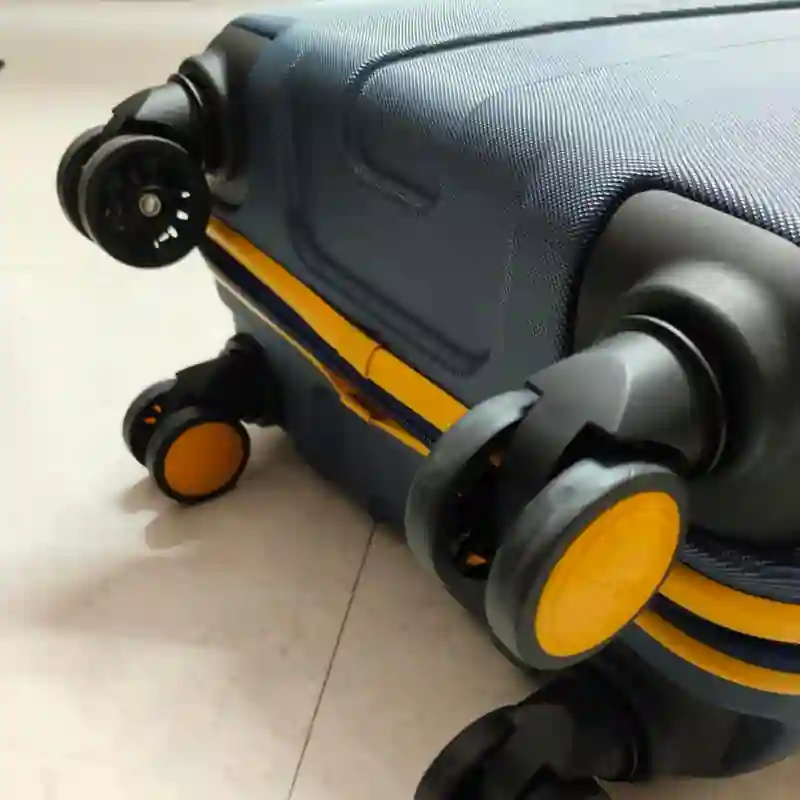
Wheels are one part people skip checking, and it’s the part that causes the most complaints later.
A suitcase can have a lovely shell and a smart interior, but bad wheels will make you regret the purchase within a few trips.
If you’re buying in a shop, actually roll the bag around and check:
- Does it move smoothly, or does it drag?
- Do the wheels wobble when you push it?
- Do they turn fully, or do they get stuck at angles?
- Is the wheel housing firmly fixed, or does it feel loose?
- Does the bag stay balanced when standing on its own?
About 4-wheel vs 8-wheel bags: wheel count is only one part of wheel quality. What matters more is how smoothly the wheels roll, how firmly they’re mounted, how well they handle direction changes, and what kind of surfaces you normally travel across.
A well-made 4-wheel spinner can easily outlast a cheaply made 8-wheel one, and each configuration has its own trade-offs depending on your travel style.
We’ve covered this trade-off in detail: 4 Wheels vs 8 Wheels Trolley Bag: Which Is Better?
6. Pull the Handle In and Out a Few Times
The telescopic handle doesn’t get enough attention, but a bad one can make even a good suitcase annoying to use.

If you can test it before buying, extend it and push it back in a few times and check:
- Does it lock firmly at full length?
- Is there a lot of side-to-side wobble?
- Does it slide back in smoothly, or does it stick?
- Does the release button work without extra force?
- Does the bag stay balanced when you pull it?
A small amount of movement is normal — that’s how telescopic handles work. But if it wobbles a lot, that’s usually a warning sign.
If you’re buying online, search the reviews specifically for words like “handle wobble” or “handle broke” before you decide.
7. Check the Zips
Zips don’t look as impressive as wheels or the shell, but a stuck or misaligned zip can ruin the whole experience.
If you’re checking in person:
- Open the main zip fully.
- Close it again.
- Repeat this two or three times.
- Pay close attention near the corners — that’s usually where zips catch first.
- Check if the zip catches the inner lining.
- Look at the stitching around the zip line.
If the bag has an expansion zip, test that one too, separately.
If you’re buying online, look through recent reviews for repeated complaints about zips getting stuck or breaking.
8. Look Inside — Interior Layout Matters More Than People Think
A lot of buyers judge a suitcase only from outside, then get disappointed once they actually try to pack it. The inside layout is where a bag either makes your life easy or gives you daily headaches.
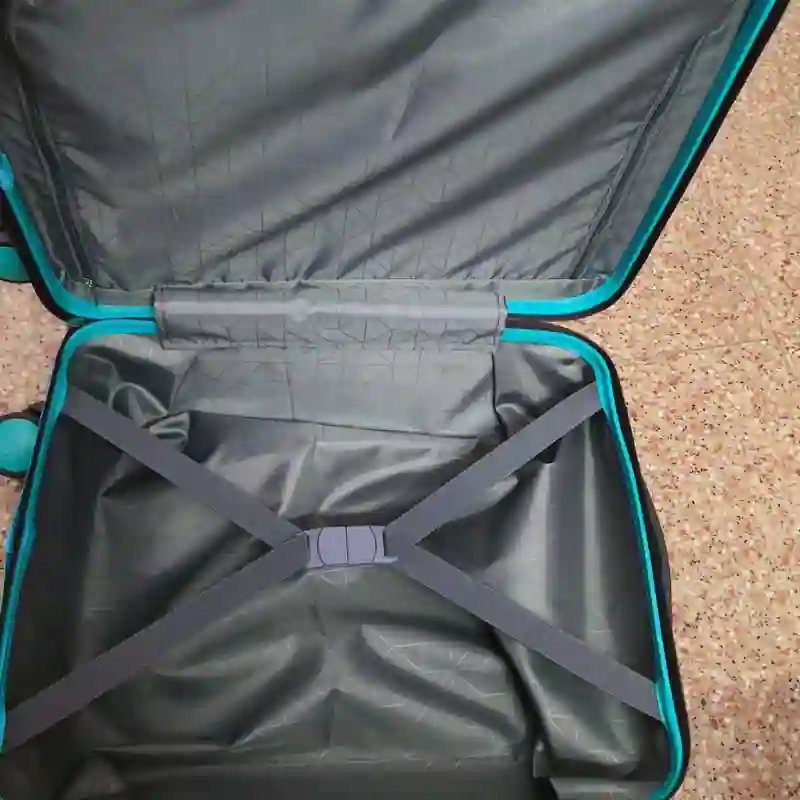
Here’s what to actually check:
Compartments and pockets Good compartmentalisation means organised packing — one side for clothes, one side for shoes or toiletries, small pockets for chargers, documents, or a power bank. If everything just falls into one big open space, packing (and finding things later) becomes a mess.
Compression straps These are the criss-cross straps that hold your clothes flat and in place so they don’t shift around every time you lift the bag. Without them, your neatly folded clothes turn into a jumbled pile by the time you reach your destination.
Laptop sleeve A padded laptop sleeve inside is genuinely useful if you’re a business traveller or carry a laptop often. Not every trolley bag has one — check specifically if this matters to you.
Interior lining Look for reasonably thick fabric with secure stitching around the corners, seams, and zip area. The fabric name matters less than the overall construction and stitching quality — a simple check is to press your finger against the lining from inside; if it feels paper-thin or the stitching looks loose, the rest of the bag’s finishing may be compromised too.
Also notice how much space the handle mechanism takes up inside — on some bags, this eats into your usable packing space more than the listing photos suggest.
Sometimes a bag with a slightly smaller advertised capacity is actually easier to pack, simply because the inside is designed more thoughtfully.
9. Check the Lock — And Know Which Type Is Right for You
Most trolley bags today come with a built-in combination lock, but not all locks are the same, and picking the right type matters.
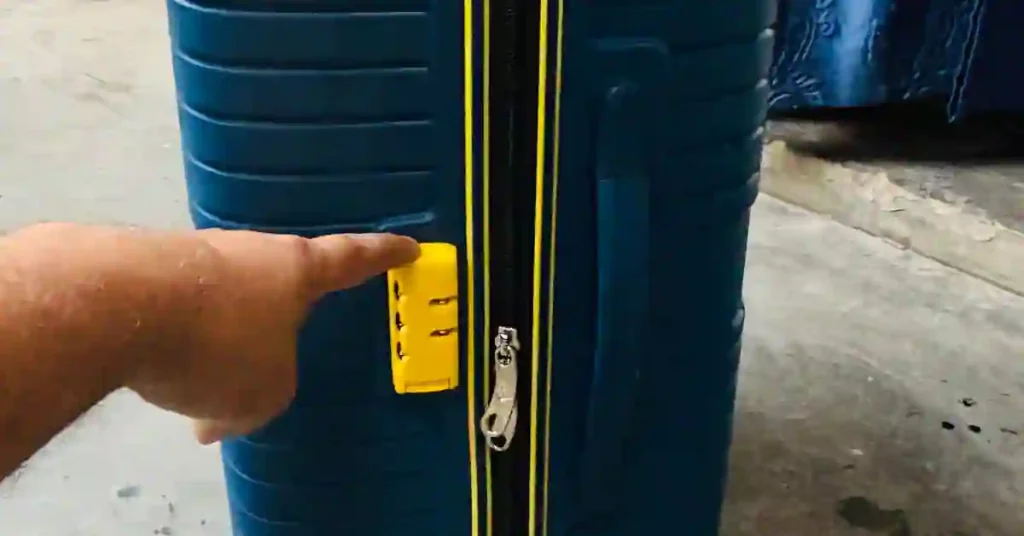
Types of locks you’ll come across:
- Built-in 3-digit combination lock — the most common type in India. Simple, no key to lose, easy to reset yourself. Fine for everyday domestic travel.
- Zip-pull padlock — a separate small padlock you attach through the zip pullers. Cheaper, but easier to remove or cut compared to a built-in lock.
What “correct” looks like when you check it:
- Does it open and close smoothly, without forcing?
- Can you reset the combination easily by yourself?
- Does the lock feel firmly fixed to the bag, not loose or wobbly?
- Is it simple to use without fumbling every time?
Do you need a TSA lock? A TSA-approved lock allows authorised security personnel to open the lock with the appropriate tool when inspection is required, rather than relying on a conventional padlock that may have to be forced open — useful mainly for international flights, especially to the US. For domestic Indian travel, don’t choose a trolley bag simply because it has a TSA lock.
Treat it as a useful feature for international travel, not a substitute for better wheels, a stronger handle, or better construction.
10. Hard-Shell or Soft-Sided?
Your usual way of travelling should decide this, not the other way round.
Go for hard-shell if you:
- Fly regularly
- Prefer a rigid, protective outer body
- Want something that’s easier to wipe clean
- Carry items that need extra protection
Go for soft-sided if you:
- Travel mostly by train, bus, or car
- Like having outer pockets for quick access
- Prefer more flexible packing
- Often need to grab small items without opening the whole bag
Neither one is “better” in general — it genuinely depends on how you travel.
Read more: Hard-Shell vs Soft-Sided Suitcase: Which Is Better?
11. Match the Bag to How You Actually Travel in India
The “best” trolley bag isn’t the same for everyone — it depends heavily on how, and where, you actually travel. And in India, that means factoring in things most global buying guides never mention: crowded platforms, monsoon rain, hill station roads, and porters who won’t always handle your bag gently.
Flying frequently — focus on low empty weight, correct cabin dimensions, smooth wheels, and a sturdy handle. Every extra kilo of bag weight eats into your baggage allowance, so this is where the fundamentals matter most.
Train travel — strong wheels, easy lifting, and a size that doesn’t fight you on a crowded platform matter more than looks. Indian Railways platforms often have gaps, steps, and uneven surfaces, so wheel build quality genuinely gets tested here.
We’ve written a full guide on this: Best Trolley Bags for Train Travel in India
Bus travel (state transport or private sleeper buses) — bus luggage holds are often cramped, and your bag gets loaded, stacked, and pulled out by handlers, sometimes with other bags on top of it. For bus travel, pay particular attention to the bag’s overall construction, handle strength, and wheel mounting.
Soft-sided luggage offers more flexibility when storage space is tight, while a well-built hard-shell can provide a more rigid, protective exterior. Also prefer a bag with a strong outer handle (not just the telescopic one), since it often gets grabbed and lifted by that handle during loading.
Monsoon season travel — if you’re travelling during the rains (June to September in most of India), water resistance matters more than people realise. A few things to check:
- Look for water-resistant construction, covered or protected zips, and a rain cover if you’re buying soft-sided luggage. No trolley bag should be assumed to be waterproof unless the manufacturer specifically states and supports that claim — check the product description and reviews rather than assuming.
- Zips with a rain flap or slightly recessed design keep water out better than fully exposed zips.
- If you’re using a soft-sided bag, a removable or built-in rain cover is a genuinely useful addition.
- Avoid light-coloured fabric bags for monsoon travel — mud and water stains show up fast and are harder to clean off.
Hill station holidays (Shimla, Manali, Munnar, Darjeeling, and similar) — hill roads mean bumpy taxi rides, narrow hotel staircases, and sometimes carrying the bag up a flight of stairs yourself when a lift isn’t available. For this:
- A lighter bag matters more than usual, since you may end up lifting it more than rolling it.
- Sturdy wheel housing is important — hill terrain and gravel driveways are hard on wheels not designed for rough surfaces.
- A bag with a solid top and side carry handle (not just the pull handle) makes a real difference when you need to lift it, not roll it.
Short trips (2–4 days) — a lightweight 55 cm cabin bag is usually more than enough. No need to overspend on a bigger bag you’ll rarely fill.
Family holidays and long trips (10+ days) — look at larger capacity, strong wheels, an expansion zip, and good interior organisation. For families, a 3-piece set (cabin + medium + large) is often better value than buying separate large bags one at a time, and it means everyone’s stuff doesn’t end up in one overloaded suitcase.
The bag that works perfectly for a Delhi–Mumbai flight might genuinely let you down on a Manali road trip or a rainy Kerala holiday. Think about the actual conditions your bag will face, not just the number of days you’re travelling for.
What if you travel in more than one way — say, mostly by train but occasionally by flight? Prioritise whichever mode you use most often, and treat the rest as “must not fail,” not “must excel.”
For example, a mostly-train traveller who flies twice a year should pick a bag optimised for train use (strong wheels, easy lifting) but double-check it still fits cabin dimensions and weighs light enough for flights — rather than buying two separate bags.
When your priorities genuinely conflict (for instance, you need both very light weight for flights and very rugged wheels for rough platforms), weight and wheel-build quality are usually worth paying extra for over interior features or looks, since those two are hardest to fix or work around after you’ve bought the bag.
12. Check Warranty and After-Sales Service
Brand, warranty, and after-sales service all go hand in hand — a warranty is only as good as the brand’s willingness (and ability) to actually honour it.
Does the brand name matter?
Yes, but not in the way most people assume. A well-known brand doesn’t automatically mean better build quality — plenty of established brands sell both premium and budget lines under the same name, and the budget lines can be quite ordinary.
What a known brand does reliably give you is easier availability of spare parts like wheels and handles, a more predictable service network across Indian cities, and a track record of reviews you can actually research before buying.
A newer or lesser-known brand isn’t automatically bad — some offer excellent value — but you’ll want to check reviews more carefully since there’s less history to go on.
Reading the warranty properly
Don’t judge a warranty just by the number of years printed on the box. A 5-year warranty isn’t automatically better than a 2-year one — what actually matters is what’s covered and how easy it is to claim.
Check if the warranty covers manufacturing defects, wheels, the telescopic handle, zips, the lock, and the outer shell — and how the repair or replacement process actually works.
Checking if service will actually be there when you need it
Trolley bags have moving parts, so at some point something might need repair or replacement. Before buying, check:
- Does the brand have service support in your city, or would you need to courier the bag somewhere?
- Can you buy replacement wheels or a replacement handle separately?
- Does the brand ask for the original bill and box when you make a claim?
- How long does a typical claim take, based on recent reviews?
- What are other customers actually saying about the brand’s service experience?
This matters more as the price goes up. For a budget bag around ₹1,500–₹2,000, basic build quality matters more than the service network.
For a pricier suitcase, after-sales support should weigh heavily in your decision — a shorter warranty with an easy, reachable claim process is often far more useful in real life than a long warranty that’s a headache to actually use.
13. Read Reviews the Smart Way
Don’t decide based on the star rating alone. A bag with 4.3 stars can still have one recurring problem that a lot of buyers are quietly complaining about.
When reading reviews, search specifically for these words:
- wheel
- handle
- zip
- lock
- crack
- broken
- warranty
- replacement
- service
If you see the same complaint repeated by many different buyers, take it seriously. One unhappy customer might just have had bad luck. Ten people complaining about the same wheel breaking is a pattern, not bad luck.
14. Compare Value, Not Just the Price Tag
The cheapest bag on the page isn’t automatically the smartest buy. Here’s a simple example:
Bag A — ₹1,499 Heavier, basic wheels, basic interior, limited warranty
Bag B — ₹1,899 Lighter, better wheels, better handle, more useful interior, better warranty
If Bag B genuinely fits what you need, that extra ₹400 is probably money well spent. The goal isn’t to find the cheapest trolley bag — it’s to find the one that gives you the most for what you’re paying.
What Should You Prioritise? A Simple Order
If all this feels like too much at once, use this rough order of importance:
| Feature | How Important |
|---|---|
| Size and dimensions | Very High |
| Empty weight | Very High |
| Wheel quality | Very High |
| Shell or fabric quality | Very High |
| Telescopic handle | High |
| Warranty and service | High |
| Zip quality | High |
| Interior layout | Medium |
| Lock | Medium |
| Looks and design | Low |
This isn’t fixed for everyone. A frequent flyer should weigh size and weight more heavily. A train traveller should weigh wheel strength and ease of lifting more heavily.
How Much Should You Actually Spend?
There’s no magic price at which a trolley bag suddenly becomes “good.” It’s more useful to think about what you get at each budget level.
Under ₹2,000 Focus on getting the size right, a reasonable weight, decent wheels, a proper shell, and a basic but functional interior. Skip the extras like USB ports or unusual designs at this price — they usually come at the cost of build quality.
₹2,000 – ₹5,000 You’ll get more choice in shell material, wheel build, interior layout, and warranty. This is also the range where comparing two or three models properly is really worth your time.
₹5,000 and above You generally get access to more options with better materials, lighter construction, stronger wheel systems, and more developed interiors, but price alone doesn’t guarantee better quality. Check everything the same way you would for a budget bag.
Looking for specific picks? See our Best Trolley Bags Under ₹5,000 in India guide.
Quick 15-Point Checklist Before You Buy
- Is the size right for my usual trips?
- Have I checked the real outer dimensions?
- Is the empty weight reasonable?
- Do I know exactly what the shell is made of?
- Are the wheels smooth and stable?
- Does the handle feel sturdy, not wobbly?
- Do the zips open and close smoothly?
- Is the inside layout actually useful for how I pack?
- Does the lock work properly?
- Have I decided between hard-shell and soft-sided?
- Does the warranty cover the parts that matter?
- Is after-sales service available near me?
- Have I read recent reviews, not just the star rating?
- Have I compared this with similarly priced options?
- Am I paying for genuinely useful features, not just looks?
5 Red Flags to Walk Away From 🚩
If you notice any of these while checking a bag in person or reading reviews, it’s usually a sign to look elsewhere:
- Wheels already wobble when the bag is brand new — this only gets worse with use, not better.
- The telescopic handle has excessive side-to-side play — a small amount is normal, a lot is not.
- The zip catches or snags repeatedly, even before you’ve packed anything.
- The listing’s dimensions are unclear or inconsistent — if you can’t tell whether wheels and handles are included, assume the worst case for cabin-size fit.
- Warranty or service information is vague — if a seller can’t clearly tell you what’s covered or where to get it serviced, that’s worth knowing before you pay, not after something breaks.
Common Mistakes to Avoid
Buying only because it looks nice. A stylish suitcase can still have weak wheels or a poor handle hiding underneath the good looks.
Going for the biggest bag “just in case.” A bigger bag is heavier, harder to lift, and often just tempts you to overpack.
Ignoring the empty weight. This one quietly costs air travellers the most — literally, in excess baggage fees.
Assuming more wheels means better quality. As we said above, it’s the build quality that matters, not the wheel count.
Only checking how many years the warranty covers. Always check what it actually covers, not just the number.
Trusting the overall star rating blindly. Dig into recent reviews for real, specific problems.
Paying extra for gimmicks you won’t use. USB charging ports and flashy designs are nice, but they shouldn’t come at the cost of solid wheels and a strong handle.
Ready to Buy? Here’s Where to Start
The brand name alone shouldn’t decide your purchase — apply the checklist above to the specific model you’re considering.
Now, based on what matters most to you:
Shopping on a tight budget? Skip straight to our Best Trolley Bags Under ₹5,000 in India — we’ve already applied the wheel, handle, and material checks from this guide to shortlist bags that hold up well without overspending.
Travelling mostly by train? Go to Best Trolley Bags for Train Travel in India for picks built around strong wheels, sturdy handles, and sizes that actually work on crowded Indian platforms.
Trying to decide between wheel types? Read 4 Wheels vs 8 Wheels Trolley Bag: Which Is Better? for a direct comparison before you shortlist anything.
Not sure hard-shell or soft-sided suits your travel style? Our Hard-Shell vs Soft-Sided Suitcase guide will help you settle that in a couple of minutes.
Comparing two well-known brands? See Uppercase vs American Tourister: Which Trolley Bag Brand Is Better? for a head-to-head look.
If none of these quite match what you’re looking for, use the 15-point checklist above the next time you’re browsing — whether that’s in a shop or scrolling through listings online — and you’ll be able to tell a well-built bag from an average one in a couple of minutes.
Final Word
A good trolley bag gets the fundamentals right: easy to move, reasonably light, the right size for your trips, sturdy enough for how you travel, easy to pack, and backed by a warranty you can actually use if something goes wrong.
What counts as “best” changes from person to person — a light cabin spinner for a solo flyer, a well-built three-piece set for a family, a tough-wheeled soft-sided bag for someone travelling mostly by train.
Start with your travel needs first, then work through the checks in this guide — dimensions, weight, material, wheels, handle, interior, warranty, and price — before you decide.
And whatever you do, don’t assume the most expensive bag, or the one with the highest star rating, is automatically the right one for you. The best trolley bag is simply the one that fits how you travel, holds what you need, and doesn’t let you down when you’re rushing to catch a flight or a train.
This guide is written by Sunil Bhatt and is based on product research, buyer reviews, specifications, and comparison of trolley bags sold in India. Read more about how we test and research products on BagInsider.
